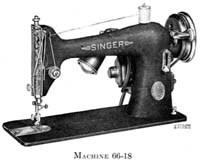
These manuals are scans taken from original Singer manuals that have been converted to Adobe PDF format for viewing/printing. Some of the original manuals are nearly 100 pages and the resulting files can be rather large, even when compressed into PDFs.
If you will right-click the links below and choose "save as" you can store these files on your own system. This is usually better than trying to view them within your browser.
Machines:
- 12K (3 MB)
- Singer 12K 'New Family', Instructions for using machine and attachments (Form K2); 12pp.
- 15-30 / 15-87 & generic 15 class machines (617K)
- 15-30 / 15-87 & generic 15 class machines - rotated for printing(617K)
- 15-91 (5.3 MB)
- 127 & 128 (2.7 MB)
- 192 Spartan (900 KB)
- Instructions for Singer's budget model (Form K6349), 4 pages. For more detailed instructions, see literature for the 99 (to which it is very similar).
- 201 (6.2 MB)
- 221K Featherweight (1.1 MB)
- The bare-necessities Featherweight manual.
- 221K Featherweight (10 MB)
- Instructions for using Singer Portable Electric Sewing Machine No. 221K, Rotary Hook, Reverse Feed, for family use, plus "Instructions for using attachments etc. which may be purchased separately" - this includes: the feed cover plate (for darning) and embroidery. Dated November 1951 (Form no. K5710).
- 221-1 Featherweight (9 MB)
- "Instructions for using Singer Portable Electric Sewing Machine 221-1 (Lockstitch, for family use with foot control). Form No. 19657." Undated. It would have been originally supplied with American machines.
- 222K Free-arm Featherweight (12 MB)
- Dated November 1955 (Form K5969). Including how to use the attachments. 96pp.
- 301 (5.7 MB)
- 319K (16 MB)
- Instructions for using the Singer 319K automatic swing needle sewing machine (1957 - 108 pages). Before computerisation, embroidery stitches had to be achieved mechanically. This zigzag machine has a set of levers on the top which, in combination with the 30 supplied fashion discs (flat cams), manipulate the byte of the needle to form dozens of decorative stitches. There was a free-arm version (320K) and together they represent probably the last of Singer's rugged, "all-metal" domestics.
- 401 (14 MB)
- Singer 401 'Slant-o-matic' zig-zag sewing machine - instructions for use; Form No. 4101; dated 1960. Slant needle machine using 'Special Discs' for decorative stitching. For electric or treadle use. Announced as "the world's first automatic with a slant needle and gear drive...". (96 pages)
- 404 (3.8 MB)
- 431 (7.9 MB)
- 503 (9.1 MB)
- Vibrating Shuttle #1 (9 MB)
- An ISMACS Exclusive! For the Singer Vibrating Shuttle machine and its attachments, supplied by the Kilbowie factory; Form No. 1443; dated 1891
Attachments & Accessories:
- Blind Stitch Attachment (4.6 MB)
- Buttonholer - Lowshank (2.3 MB)
- Buttonholer - Oldstyle (1.2 MB)
- Buttonholer - Professional (1.5 MB)
- Edgestitcher (2 MB)
- The Edge-stitcher: Singer attachment instructions; 4pp; 1916.
- Even-Feed / Walking Foot (7.2 MB)
- In two languages!
- Flat-Work Darner (1.2 MB)
- Foot-Bar Attachments (5 MB)
- "Directions for using The Singer Manuf. Co.'s 1888 (Foot-bar) Set of Attachments" for the Improved Family and VS2 machines. It's a manual for the first puzzle box (which was patented in 1889); this is dated 1889. The ruffler and tucker are very early styles (patented 1888).
- Needle Threader (153 K)
- Zig-Zagger (3.8 MB)
Wiring:
- Wiring (402 K)
- Contains Featherweight-specific, and generic, wiring diagrams
You will need Adobe Reader to view or print these files. You can download it here.